Rereading Sapiens over Christmas, Harari argues that much of human progress in the past 500 years runs on a compounding loop between science, capital, and empire. The surprising part is what starts this loop: discovery of ignorance as a mindset shift.
The scientific revolution wasn’t simply a surge in knowledge, it was a new public relationship to what we didn’t know. Pre-modern societies often assumed the big questions were already answered by God, tradition, or inherited authority, whereas early modern Europe started to admit the unknowns and build plans to explore it.
Maps of ignorance
As a fun visual comparison, we can see this shift in maps. Many medieval maps fill the unknown edges with creatures and stories. But by the early 1500s, maps like the Salviati Planisphere start leaving some unexplored regions unfilled rather than inventing detail. Blankness becomes a public admission that we don’t know what’s here yet, and an invitation to go find out.
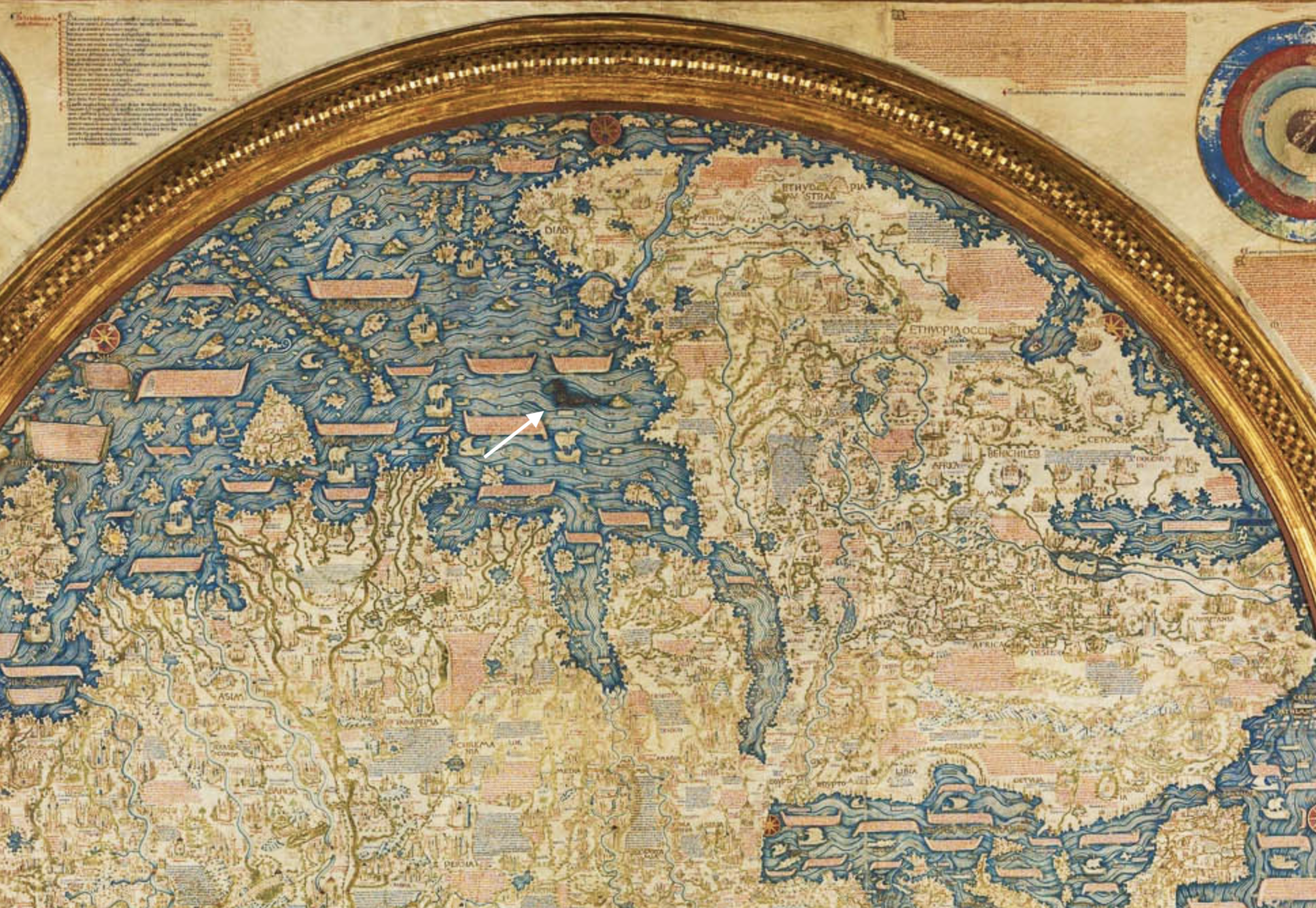
Fra Mauro (1459)
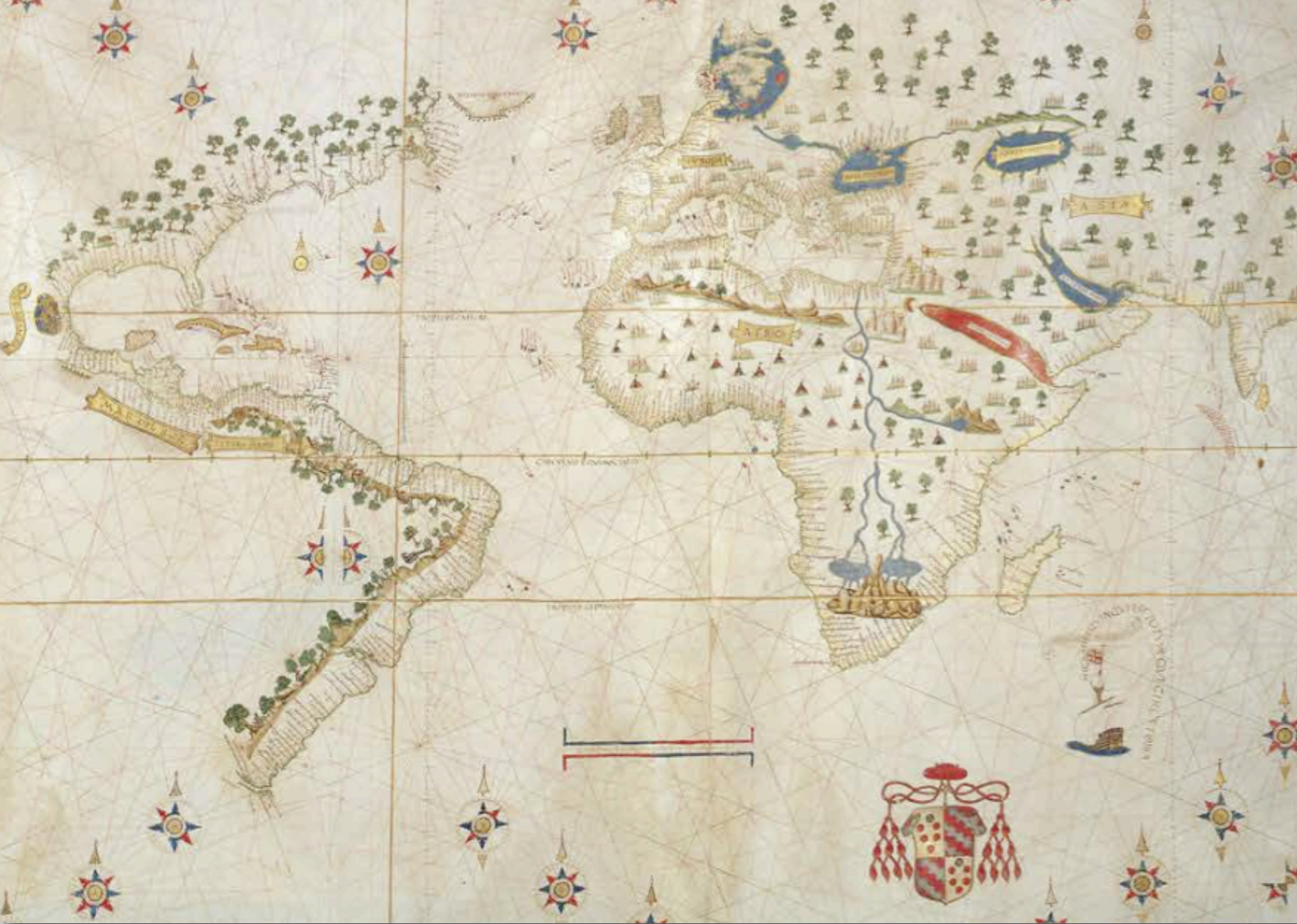
Salviati Planisphere (1525)
That small design choice signals an ideological breakthrough shared by scientists and conquerors: they admit they’re ignorant of large parts of the world, so they need to go out to discover, which expands both knowledge and territories.
Compounding loop: Science ↔ Capital ↔ Empire
Here’s the loop. Science turns blank space into knowledge. Capital funds exploration before there’s proof it will work. Empire converts discovery into durable advantage—routes, treaties, control, legitimacy. And then it compounds: advantage brings more capital; more capital funds more exploration.
In 2025, “empire” often looks less like territory and more like an integrated stack: silicon, energy, cloud capacity, proprietary data, and default distribution. The advantage goes to players who can fund long cycles of exploration, translate discovery into products people actually use, and defend/scale the resulting position through contracts, platforms, and habits.

Photo by Francesco Ungaro on Unsplash
What would this look like in the age of AI?
The AI map is also mostly blank. We don’t fully know what models will reliably do in the wild. We don’t know what people will trust. We don’t know what becomes habit versus novelty. So my hypothesis is: enduring advantage in AI will come from teams that can own the exploration loop, not teams that land a single breakthrough.
Capital and infrastructure fund and enable exploration. Exploration produces knowledge. Knowledge creates power and advantage. Advantage attracts more capital. Model talent matters, but the dominant advantage comes from owning the loop (compute, data, distribution, real-world feedback).
In the 1500s–1800s, “exploration” meant ships, navigators, maps, ports, financiers, and state backing. In AI, exploration means running huge numbers of experiments (training and inference), but the constraints are different: compute, energy, deployment surfaces, and feedback loops.
Energy access is a clear example of a physical gate. Whoever secures it early can run more experiments, iterate faster, deploy more capacity, and earn more real-world feedback. That can translate into higher quality, broader distribution, more revenue, stronger habits, and then more capital to secure more infrastructure.

Photo by Amy Humphries on Unsplash
Two versions of the loop
OpenAI × Microsoft is the industrial-scale version: capital, compute, distribution, and governance intentionally linked. Microsoft has explicitly described a “multiyear, multibillion dollar” investment partnership, and the relationship is designed around turning frontier exploration into real-world deployment at scale.
Midjourney is the tight-loop version: a small but mighty team exploring a narrower knowledge gap (what people want in images and taste). They built a capital loop through subscriptions (steady funding to buy compute and keep iterating). Importantly, they built distribution and feedback through a community workflow (Discord), and as they moved into more compute-intensive territory (video), they emphasized that video generations cost significantly more GPU time than images.

What would prove this wrong?
This hypothesis depends on exploration staying expensive, uncertain, and cumulative. It fails if those conditions disappear. If small teams can reliably reach frontier capability without sustained access to compute, energy, or distribution, then the “capital + empire” advantage stops compounding. If distribution alone can dominate, through defaults, bundling, or platform control, then learning velocity becomes secondary to placement. And if efficiency gains make experimentation cheap enough that almost anyone can run the loop, then infrastructure ceases to be the bottleneck, and advantage migrates elsewhere.
We’re already seeing early stress tests. Efficiency jumps suggest capability may be less capital-gated than people assume (e.g. DeepSeek). And platforms are clearly pushing default distribution (e.g. Apple Intelligence becoming default-on; Microsoft Copilot can be auto-installed via updates), which could make “control” matter more than “learning” in some contexts. The open question is whether these are exceptions or the early shape of the next loop.

What I’d watch
If this framing is right, the interesting question isn’t “who has the smartest model,” but “who can sustain the exploration loop long enough to learn.” The strongest teams are the ones whose products get used, whose revenue funds more learning (revenue ties to real usage, clear feedback, and repeat behavior), and who take constraints like compute and distribution as important product problems, not just things to buy later.
I would be wary of teams that are strong in one area only but weak in others: great tech nobody uses, wide reach with shallow learning, or lots of spending without clear feedback.
🥳 And that wraps 2025
Looking forward to your thoughts, ideas, and pushbacks! And that wraps all the blog posts in 2025. Thank you for supporting this newsletter as we explore Singapore policy, game design, Moore’s law, shanxi architecture, writing as a cognitive tool, and broadway musical production together—it has been a wild ride. Wishing everyone a happy new year ahead in 2026!