Happy new year! I started the new year traveling in Shanghai, Jingdezhen, Shenzhen, and Zhongshan, each city with different energies and showing a different side of cool things happening in China. Shanghai and Shenzhen to learn from the tech ecosystem, Jingdezhen for a pottery retreat, and Zhongshan for seafood and chill vibes in my home city.

Jingdezhen tea space
What’s new for Soft Patterns in 2026? You will start seeing short essay series, where I go deep on one idea across 2–3 posts. We ended 2025 with the idea of an exploration loop, first sparked by Sapiens. This post is part two: a look at how that loop shows up in Shenzhen, and why China’s hardware and consumer tech system works so differently from Silicon Valley’s.
From factories to hardware R&D labs
In December, we explored the idea that players with an exploration loop between capital, science, and an integrated stack (energy, data, and distribution) get more advantage because they can fund long cycles of exploration and translate them into habit-forming products at scale.
Shenzhen is a clear example. The city is known for physical AI industries, from robotics, drones, smart EVs, sensors, to wearables, and for getting from prototype to production unusually fast.
That speed comes from two feedback loops:
The first is loop is fast prototyping (0 to 1). In Silicon Valley, engineers often wait weeks for custom parts. In Shenzhen, you can go to Huaqiangbei and come back with rare sensors, custom battery packs, or unusual subassemblies the same day.
The second is fast industrialization (1 to 100K) and building with the factory on the manufacture floor. In Silicon Valley, an engineer may design something that looks great in CAD but becomes painful to manufacture. In Shenzhen, factory teams give immediate feedback: they’ll tell engineers exactly how a screw placement slows down the line, or why a design choice raises defect rates.
That kind of tight feedback, repeated every week, makes teams better at building real products, not just prototypes, whereas US engineers often deal with manufacturing constraints later in the cycle. The co-location of R&D and manufacturing (often within an hour) turns the city into a working lab.
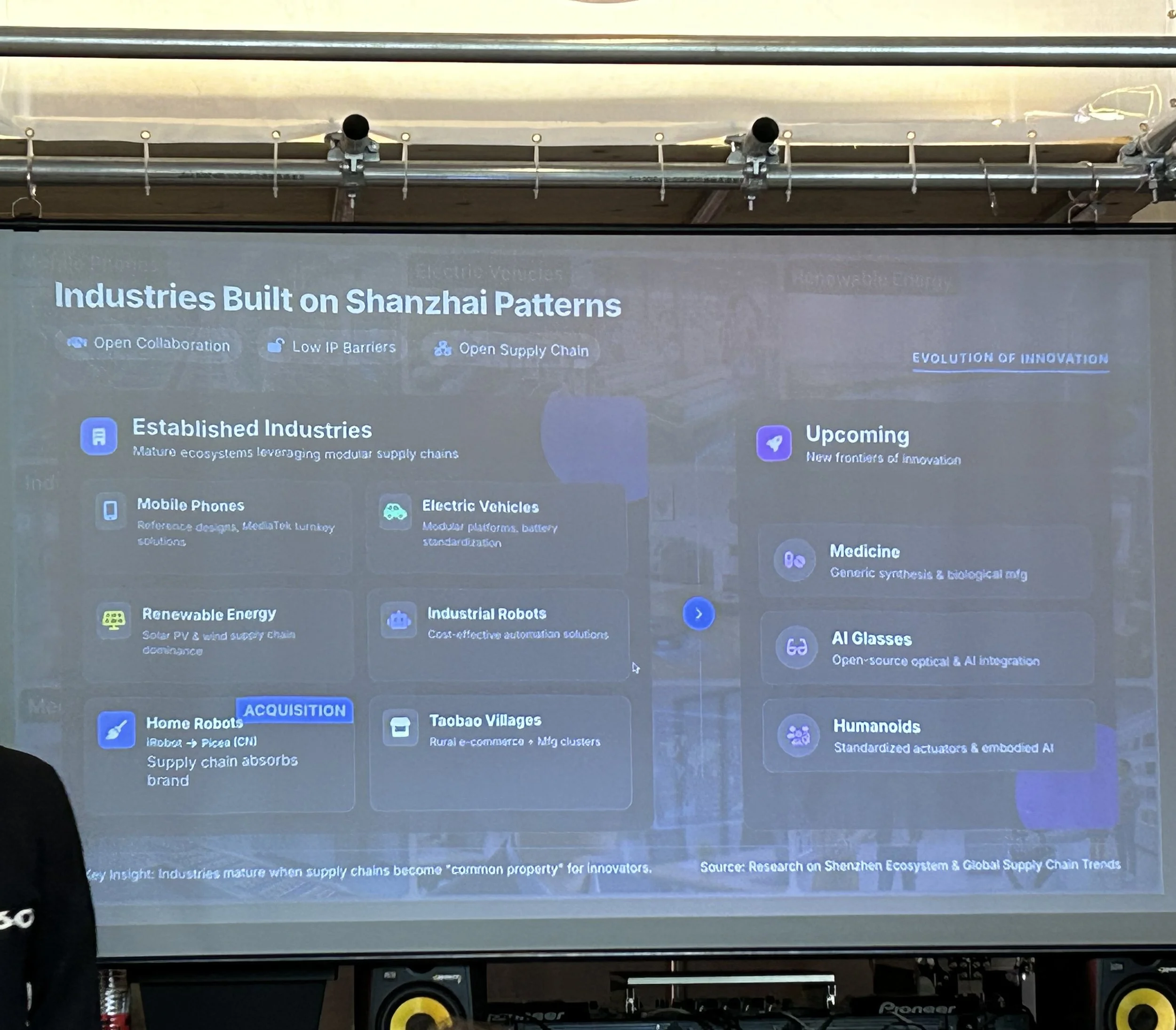
Shenzhen Innovation patterns, from David Li
Hardware legos lower the cost of being curious
In most markets, when hardware parts become cheap and standardized, people worry about margins falling (i.e. commoditization). And they’re not wrong: once a product ships, competitors can often copy it and sell something similar quickly.
In Shenzhen, cheap standard parts are also a big advantage because they lower the cost of trying things. Because the city built the world’s smartphones, it created a thriving marketplace of “standard parts.” Specialized tech components (like a brushless motor or camera module) are now so cheap that the cost of experimenting with them becomes small.
This changes behavior:
Each experiment costs less: If you picked the wrong sensor, you learn quickly and move on.
Mix and match becomes normal: Teams can combine modular parts like legos and focus on the product experience (e.g., drone's flight logic) instead of reinventing basic components.
With China’s large domestic market and dense engineering talent, this creates a culture that rewards speed and iteration. That’s where the “shanzhai” (counterfeit products) reputation comes from: fast cycles, intense competition, and constant incremental upgrades.
This is different from Silicon Valley’s dominant pattern: long timelines for big bets, often built on research-heavy breakthroughs and multi-year funding cycles, especially in software.
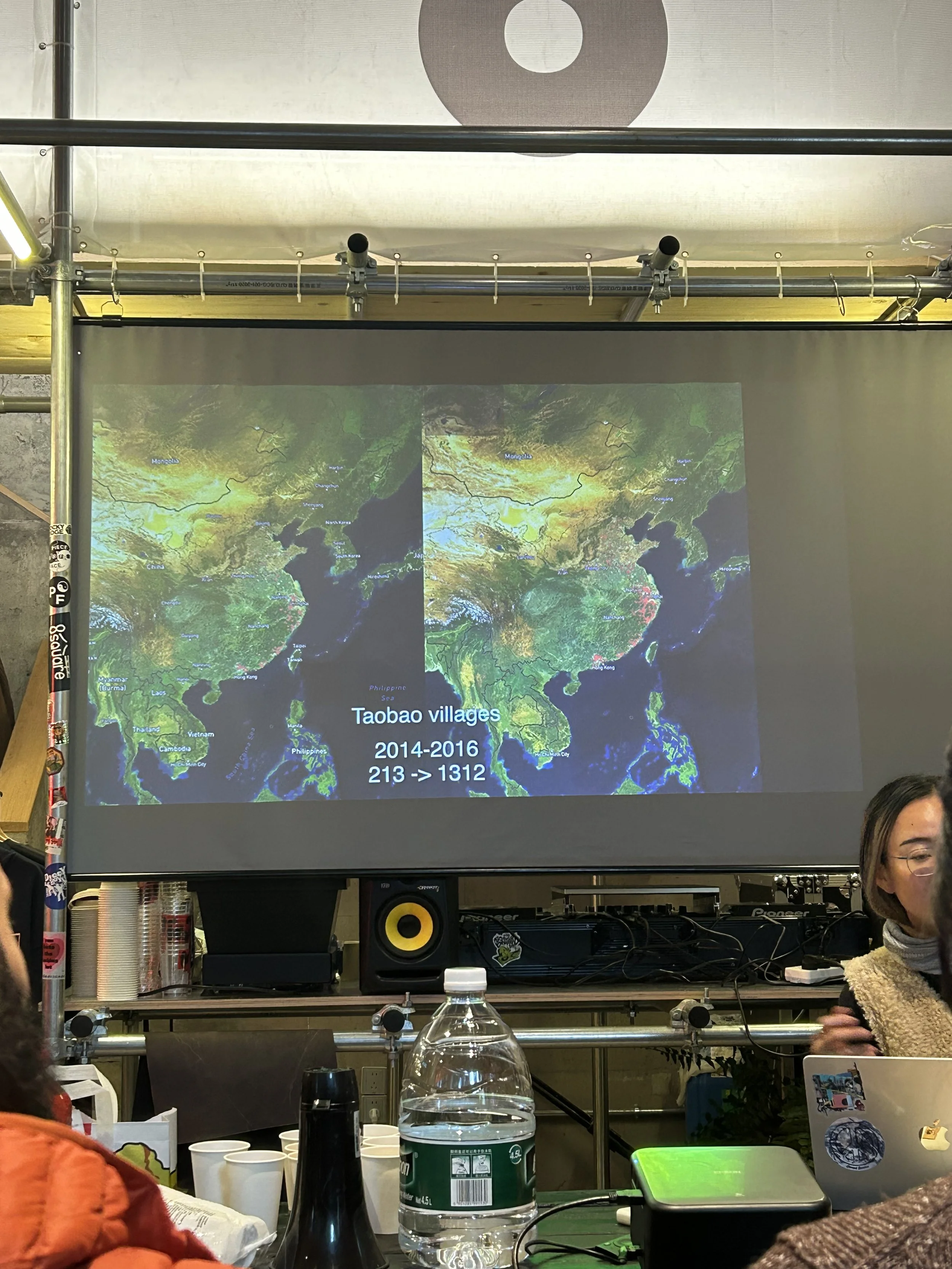
Field research for Taobao village, from Xiaowei Wang
Who benefits most?
Shenzhen is great at scaling and mass production once the building blocks exist (e.g., making the most affordable, AI-powered drone, 1-100K). Silicon Valley is great at creating new categories when the breakthrough is still uncertain (e.g., creates the first LLM, 0-1).
As AI interacts with the physical world, speed in real-world testing matters more. It’s not only about making hardware cheaper, but also running more real experiments per month.
So what kinds of business benefit from a Shenzhen’s system?
Consumer electronics is the iconic category: smartphones, drones, wearables, robotics, foldables. These are not life-critical tools like medical devices, so they thrive on a “ship-and-patch” culture where teams can ship earlier, learn from users, and improve quickly. The product becomes a live test in the market.
As a result, there are three ways the market shifts:
Cheaper components let smaller teams build serious products. Companies like Insta360 became possible because key smartphone-era components (GPS, cameras, batteries, IMUs) became cheap and widely available first.
Standard interfaces create huge accessory businesses. When hardware standardizes (USB-C, Bluetooth, common mounts), it creates a predictable and large market for accessories, like the multi-billion dollar case and charger industry.
Big players can push prices down until smaller players can’t survive. Sometimes the winner isn’t the most inventive, but the one that can survive thin margins the longest, force the market to standardize, and scale the fastest.

Shanghai Jing’an Temple
When does the Shenzhen loop break?
This system breaks when the value of the product depends on something can’t buy off a shelf:
Unique physical data: A drone company shouldn't just be iterations of motors, but the iterations of navigation data collected by those motors. The advantage is the edge-cases the AI has learned because the hardware was cheap enough to deploy at scale.
Taste and status: The “cool” factor. People buy a Leica for feel and identity, not because it has the cheapest sensors.
Hard science breakthroughs: Some things can’t be sped up by supply chain alone. Quantum computer can’t be built by combining off-the-shelf parts. Though companies like Unitree show how far iteration can go in robotics (e.g., a humanoid robot can be bought at the cost of a used car).
Ecosystem lock-in: The 'sticky' factor. Apple doesn't have to be first because once you have the phone, the watch, and the laptop, leaving is too much of a headache.
What I’d watch next
A few practical filters:
Cost of each learning cycle: Does this product get meaningfully better each time the team ships and learns? If yes, Shenzhen-style iteration can be a real advantage. Or that it’s positioned to stand out using things that can’t be bought off a shelf (e.g., taste-driven brands, deep tech, platform ecosystem).
Avoiding commoditization: As teams grow, do they keep moving fast, or do they slow down when production becomes more complex? If they slow down, what do they build that keeps them ahead: better software, better data, better brand, better ecosystem?
Design for manufacture: For US teams working on hardware AI, I’ll watch when design and assembly are far apart, what frictions show up? Communication delays, part lead times, and “late surprises” can quietly drag down speed.
Global standards and trust: Teams that ignore compliance and trust early often hit a wall outside China. I’d watch how early they design for global expectations: data handling, security, certifications, and component compatibility.
In the next post, we will deep dive on a Shenzhen startup as a concrete example that used this high-velocity loop to outcompete industry leaders in the consumer electronics market. Stay tuned!
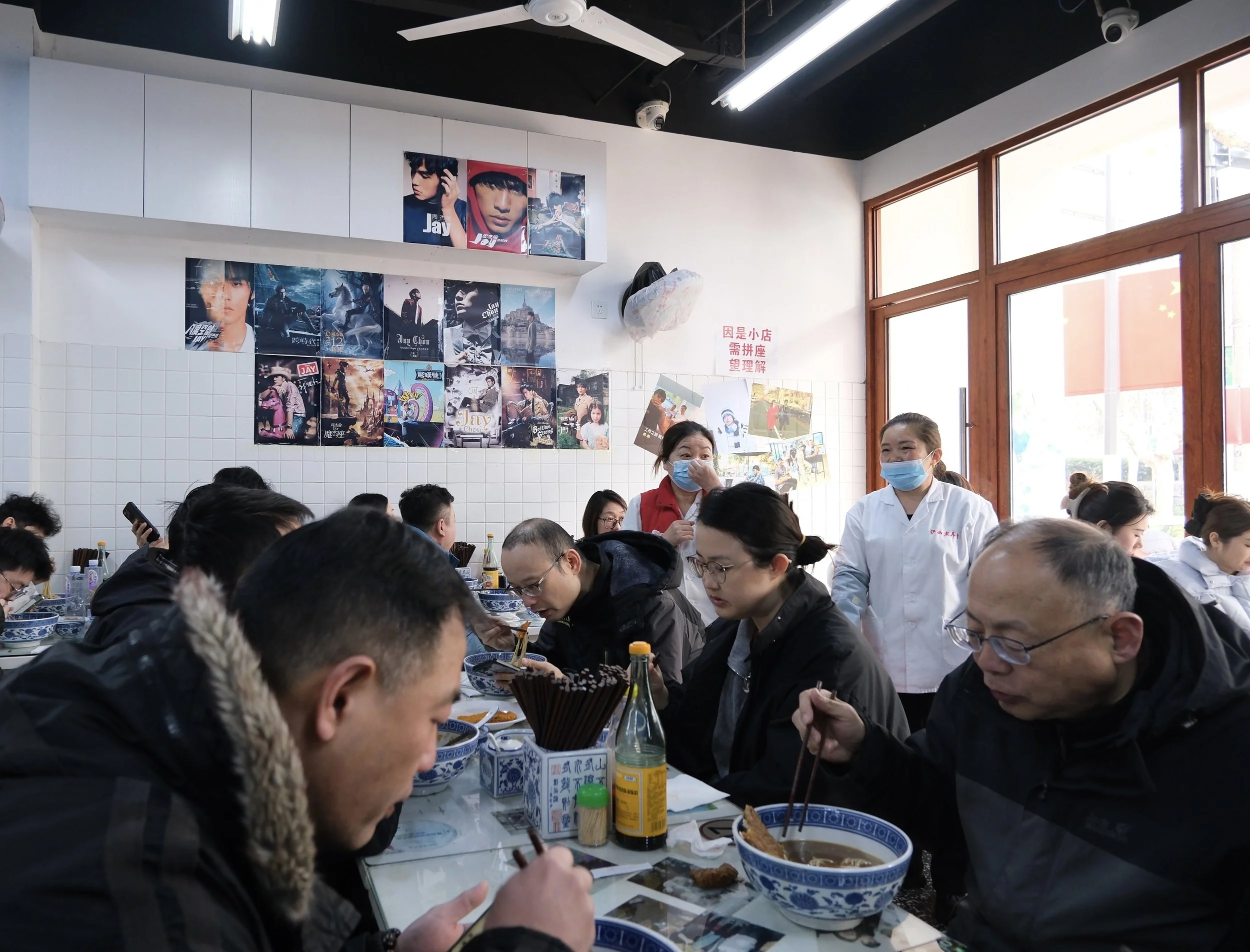
Random, but I love how the owner of this noodle place clearly loves Jay Chou haha